
JOHN CLARKE
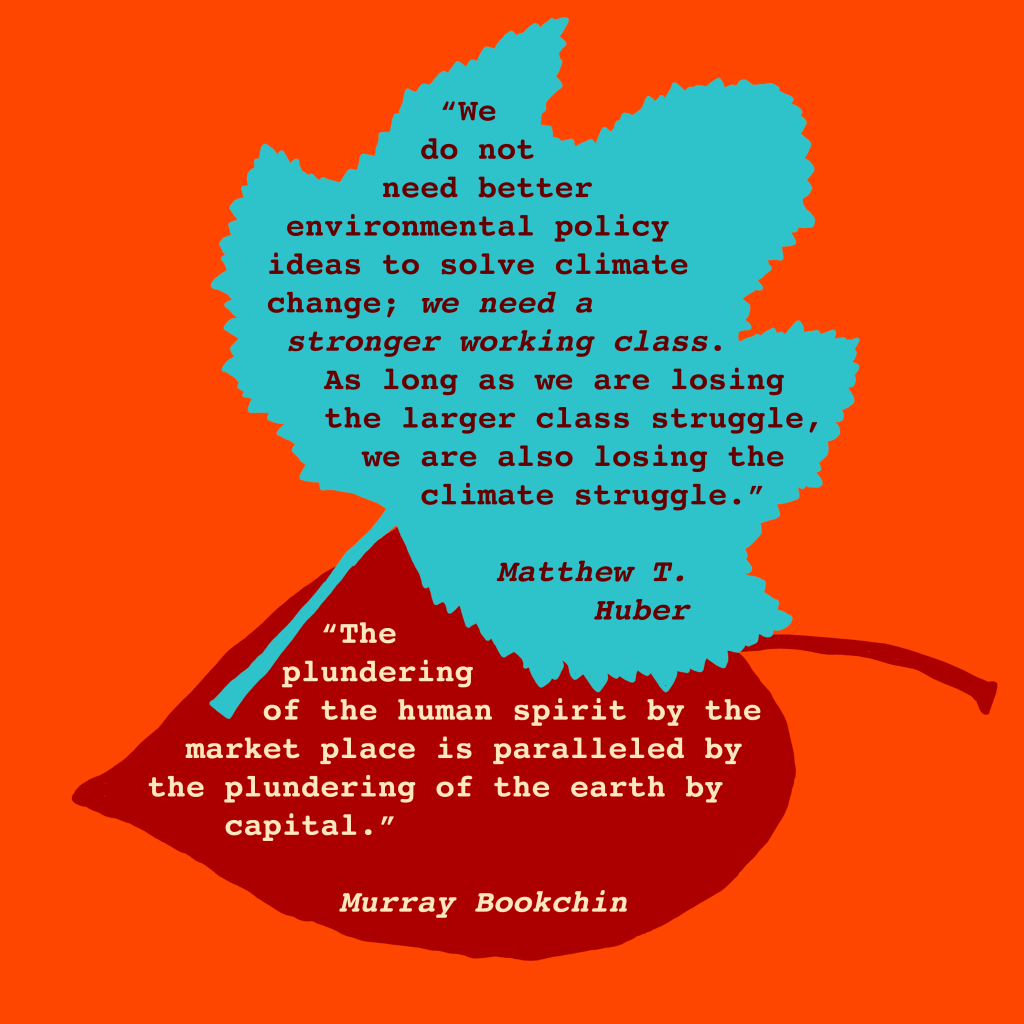
When the term ‘class struggle’ is used, we often think of strikes for better wages and improved working conditions or perhaps mass protests on the streets challenging social cutbacks. However, I’m going to argue that the rapidly developing climate disaster has everything to do with the class struggle and, indeed, will have the most profound impact on what working-class people must fight for and the nature of their struggles.
First of all, it is already abundantly clear that, just like the spread of the Covid pandemic, the impacts of climate change will play out along fault lines of social, racial, and global inequality. Even in wealthy countries, the destruction and devastation caused by extreme weather, wildfires, rising sea levels, and other climate effects will threaten people and communities who have the fewest resources and the most limited options to a much greater degree. In the Global South in particular, it is already horribly clear that the results of climate change mean catastrophic suffering.
As climate impacts intensify, those who face the worst consequences and who are being abandoned in the face of them will have to struggle to survive. They will have to advance demands and develop strategies and forms of organisation to confront those with economic and political power. The climate issue will be placed at the heart of the class struggle in country after country.
Assault on the natural world
Climate change and the broader environmental crisis are unfolding in a world that is dominated by capitalism and this deeply impacts how we must respond. A just and rational society would take urgent measures to curtail carbon emissions and transition to sustainable forms of economic activity. It would also, in a spirit of co-operation and solidarity, take the measures that were deemed necessary to minimise the impacts on the global population. Neither of these responses can be expected under the present system.
In his Capitalism in the Anthropocene: Ecological Ruin or Ecological Revolution, John Bellamy Foster argues that capitalism’s competitive drive to generate profits and accumulate is at odds with creating a viable relationship with the natural world. He suggests that we face an ‘irrational system of artificially stimulated growth, economic waste, financialized wealth, and extreme inequality’ that threatens our existence. (2022 p75)
The evidence to support such a view is wide ranging and abundant. The escalating impacts of the climate crisis are to be found in the greatly increased levels of extreme heat, devastating droughts, violent storms, wildfires, and floods. However, the appalling failure to act in the face of these catastrophic impacts is an even more compelling reason to draw anti-capitalist conclusions.
In June 2024, the Guardian reported that ‘the world’s consumption of fossil fuels climbed to a record high last year, driving emissions to more than 40 gigatonnes of CO2 for the first time, according to a global energy report.’ There is, moreover, nothing at all accidental about such a terrible development. Shell’s CEO Wael Sawan, responding to a question about renewable energy sources, was very forthright when he stated, ‘We will drive for strong returns in any business we go into… Our shareholders deserve to see us going after strong returns… Absolutely, we want to continue to go for lower and lower and lower carbon but it has to be profitable.’
The conclusion that fundamental social change is needed is absolutely vital, but we must also ask ourselves how we can organise to make a difference in this society at the present dangerous moment. Foster’s book puts forward the notion of an initial ‘ecodemocratic phase’ in the struggle that would ‘demand a world of sustainable human development.’ This would then go over to a ‘more decisive, ecosocialist phase of the revolutionary struggle’. (p78) Taking this perspective as a starting point, we can consider how we might organise and what our goals might be as the scale and intensity of the climate disaster intensifies.
The first and obvious consideration is to do all we can to stay the destructive hand of fossil fuel companies, banks, and other capitalist interests that have set us on the present path to environmental catastrophe. We must develop and apply the forms of mass action that can lead to the curtailing of emissions and the transition to renewable energy sources. In this regard, we are hardly starting from nowhere because a vital struggle for climate justice is already well and truly underway.
Climate movements have held mass rallies and organised ongoing campaigns to press their demands, and they have forced governments onto the defensive. There have also been more militant actions to actively disrupt the workings of fossil fuel companies and those who finance and enable them. This emerging wave of social resistance is global in its dimensions, and we can only expect that the dire nature of the climate crisis will continue to drive this struggle.
Finding the way forward for the climate movement will involve a great deal of discussion, debate, and experimentation, in order to develop effective strategies. However, a basic point of agreement that I would argue is essential is that capitalist interests and political power structures must be faced with mass resistance and determined challenges if they are to be forced to make concessions. Those who think that they can win meaningful change by dialoguing with political leaders and fossil fuels lobbyists at climate summits are sadly mistaken. The United Nations Conference of Parties (COP) gatherings are a diversionary hoax that needs to be exposed and challenged for what it is.

Climate impacts
As the effects of climate change become ever more extreme, which is now happening with unanticipated and alarming speed, it becomes starkly obvious that we are in nothing less than a struggle for survival. It is clear that many of the severe consequences that flow from climate change are now unavoidable. Populations are already being exposed to dire climate impacts and, even if we could make the transition to responsible environmental stewardship today, they are still going to get very much worse.
We may reasonably conclude that a social and economic system that wilfully compounds a planetary climate disaster is unlikely to place any more emphasis on keeping the mass of people safe in the face of that disaster than it is compelled to do. All that lies between us and social abandonment is our ability to challenge those in power with sufficient strength and determination to ensure our demands are met.
Working-class people will increasingly be faced with very major climate impacts in their workplaces and in the communities they are part of. The impacts of climate change are already a vital and pressing workers’ issue. Justice for Migrant Workers (J4MW), which organises migrant farm workers in Ontario, Canada, is demanding that the government of that province ‘implement emergency measures to protect farmworkers from extreme heat.’ J4MW notes that ‘farm workers are also 35 times more likely than the rest of the population to die of heat exposure.’
In New York City, delivery drivers are challenging gig economy employers over their repeated exposure to heat as they go about their jobs, and there are many such examples in a range of countries. In fact, the International Labour Organisation (ILO) suggests that ‘more than 2.4 billion workers (out of a global workforce of 3.4 billion) are likely to be exposed to excessive heat at some point during their work.’
In this dire situation, employers and governments are already trying to ensure that vital protections are denied to the greatest degree possible. In April 2024, Ron DeSantis, the right-wing governor of Florida, passed a measure that ‘bans local governments from requiring heat and water breaks for outdoor workers.’ Florida is, of course, a state that experiences a great deal of hot weather and where ‘construction and farming are huge industries.’
Other climate impacts will create the need for action by workers and their unions to an ever-greater degree. Extreme weather, floods, and wildfires will produce levels of destruction and dislocation that will involve major job losses, and chronic impacts such as drought will have huge economic effects. It will be necessary to ensure that public services and social benefit systems are greatly expanded and improved so that the climate crisis doesn’t lead to the social abandonment of displaced workers.
As the struggle for a just transition away from fossil fuels unfolds, the power of organised workers will be essential. It will be necessary to ensure that transition proceeds as rapidly as possible, and the strike weapon must be used to compel employers and governments to act. It will also be vital, however, to ensure that, as environmentally destructive industries are replaced, workers aren’t simply discarded. It has been recently noted in the case of the UK, for example, that North Sea oil workers mustn’t experience the same fate as the miners in the 1980s.
The worsening climate crisis will require decisive community-based resistance as well, and this will require the forging of a deeply rooted solidarity for survival. Certainly, the self-organisation that emerges will involve co-operative and mutual support initiatives that must develop in the face of adversity. However, state resources to deal with damage and disruption will have to be demanded and won as a matter of priority.
The situation that is developing requires that comprehensive plans and measures be put in place to deal with extreme weather and the chronic effects of climate change. The UK’s Climate Change Committee (CCC) warned in May 2024 that the country is ‘absolutely lacking’ in climate adaptation measures, placing agriculture, supply chains, power systems and public health at risk.’ Emergency services must be adequate, plans to evacuate threatened areas must be in place, and degraded healthcare systems and other public services must be strengthened to deal with disasters and lingering climate effects.
The process of planning to deal with these worsening impacts can’t be left to political leaders and unaccountable bureaucrats. Communities will have to develop vital demands around their safety and well-being and take decisive action to ensure that they are met. Emergency food supplies and distribution systems must be in place. An infrastructure of survival must be established, from public cooling centres during extreme heat, to places of safety that can be accessed in the case of storms and floods. Safety and survival can’t be the exclusive preserve of those who have the money to buy these things.
Global South
The imperialist world order we live under is based on a division between wealthy exploiter countries and those that are poor and exploited. Climate change brings a new and terrible element of inequality and injustice to this situation. The populations of the Global South contribute little to the climate crisis, but they must endure its impacts to a vastly disproportionate degree.
Waseem Ahmad, chief executive of Islamic Relief Worldwide, has noted that ‘as climate-related catastrophes increase, it is the poorest and most vulnerable people who bear the brunt of the suffering. They are the ones most likely to live in fragile homes and least likely to have savings to fall back on, or assets to sell, or any kind of “Plan B” when floods hit and crops and livestock are wiped out.’
In 2022, Pakistan was hit by the worst flooding in living memory and vast portions of the country were directly impacted. It is estimated that 33 million people lost their homes, land, or jobs. One year after the floods, ‘researchers from Islamic Relief who talked to people in the flood-affected areas found 40% of the children they surveyed had stunted growth and 25% were underweight as families struggle[d] to access food and healthcare.’
Yet, the countries of the Global South are crushed by debt, which they largely owe to institutions and banks that are based in rich countries. Last December, it was reported that the world’s poor countries were having to allocate 38% of government revenues to debt servicing, 54% in the case of African countries. Pakistan’s acute debt crisis has just been staved off with a $7 billion loan. This will buy its government a bit of time, but, in return, the IMF will require more commitments to impose austerity measures on the impoverished population. The country’s malnourished children will stay hungry so that bankers in the West can be paid off.
As the debt crisis continues to cause immense harm and suffering in the Global South, the most powerful countries haggle at international summits about establishing a modest international fund to respond to the needs of impoverished countries that are harmed by the impacts of climate change. A Loss and Damage Fund is in the works, but, measured up against the vast debt load imposed on ‘developing’ these countries, it is hopelessly inadequate.
Clearly, the movement that we build in the face of climate change must be solidly rooted in the principle of international solidarity, and this must involve an uncompromising struggle against the exploitation and abandonment of the Global South. In place of ‘debt relief’, we need the full repudiation of debt. The needs of poor people across the world are of much greater importance than the claims of parasitic lending institutions. When storms, floods, and drought cause destruction and dislocation, the resources needed to survive and rebuild must be available on a scale that far exceeds present token gestures.
The UN refugee agency estimates that, between 2008 and 2016, ‘21.5 million people were forcibly displaced each year by weather-related events.’ It also suggests that 1.2 billion people ‘could be displaced globally by 2050 due to climate change and natural disasters.’ Already, we see racist border enforcement and other methods being employed to try and exclude those driven by poverty and destabilisation to seek safety in Western countries. The years ahead will see millions of ‘climate refugees’ struggling for survival in this way, as portions of the earth become effectively uninhabitable. In such a catastrophic situation, the response to this forced movement of people must be just and viable on an international scale.
It becomes clearer with every passing month that the class struggle is being reshaped by the climate crisis. Capitalism’s inability to create a sustainable relationship with the natural world is having devastating and rapidly worsening consequences for the bulk of humanity. Left to their own devices, those with economic and political power won’t address the factors that are driving the crisis, or deal properly with the now inevitable climate impacts. The class struggle that we take up must be based on an active solidarity for survival and the goal of a rational and just society. In the face of the existential crisis that we are now confronting, there is simply no other way forward.
 Climate and Class